International Removals to Dubai: What a Posting Involves
International Removals to Dubai: What a Posting Involves
International removals to Dubai look straightforward on paper and rarely are in practice — and when the move is a diplomatic or mission posting rather than a private relocation, the paperwork, the timings and the packing standards all change. This guide is written for the person who actually books the move: the mission HR coordinator at a London embassy or consulate, the administrative attaché arranging a rotation to Abu Dhabi or Dubai, and the families who arrive at the far end of it. We are The International Mover, part of The Mover Group, and this is what a Gulf posting genuinely involves.
We work alongside our diplomatic arm, and the two overlap constantly. If you are arranging a mission move rather than a private one, read this piece together with our guidance on diplomatic household goods shipping from London and our briefing on the five questions every embassy HR director should ask. Those two pages carry the protocol detail; this one covers the Gulf specifics. You can also see the full scope of what we handle under The International Mover, and if your mission also rotates staff westward, last week's guide to UK–USA relocations from London covers the same ground for North American postings.

What actually changes when a posting moves from London to a Gulf mission?
Three things change immediately: the customs route, the physical environment, and the calendar. A UAE household goods clearance for mission staff runs on privilege documentation issued through the Ministry of Foreign Affairs and the receiving mission, not on a standard resident's import declaration. The heat and humidity impose packing standards London moves never require. And Ramadan and the summer peak compress the workable year.
Beyond that, the shape of the household changes. A London posting is often a flat or terraced house with a loft, a garage and a shed. A Gulf posting is usually a villa or serviced compound property that arrives furnished or semi-furnished, air-conditioned throughout, with generous storage but very different room proportions. Large soft furnishings that suited a Victorian sitting room frequently do not suit a villa reception room, and the reverse is also true — families going out often need less than they think, and families coming back need more.
The other change is the length of tenure. Postings are finite. That single fact reshapes every decision about what to ship, what to leave in the UK and what to buy on arrival, and it is the reason so many mission moves are actually two projects running in parallel: an outbound shipment and a UK storage account that has to survive three or four years without anyone visiting it.
What does UAE customs require for household goods — and what does a mission move require that a private move does not?
A private relocation to Dubai from the UK clears on the owner's residence visa, Emirates ID, passport copy, a detailed valued packing list and a bill of lading or air waybill. A mission move adds a layer: privilege or duty-exemption documentation raised by the receiving embassy or consulate, verified through the UAE Ministry of Foreign Affairs, plus the diplomatic ID or visa reference of the assigned officer. Both routes need accuracy. Only one needs protocol.
The documentation set for a mission shipment
- Passport and visa or diplomatic ID copies for the assigned officer and every accompanying dependant, matching the names on the consignment exactly.
- Duty-exemption or privilege letter raised by the receiving mission and endorsed by the UAE Ministry of Foreign Affairs, naming the officer, the mission and the shipment.
- A detailed, valued inventory in English, itemised rather than summarised. "Box of books" will not clear. Numbered cartons with contents and declared values will.
- Original bill of lading or air waybill, released to the correct consignee — which for mission shipments is frequently the embassy, not the individual.
- Certificate of origin or purchase paperwork for high-value items: fine art, antiques, musical instruments, watches, jewellery, wine.
- Vehicle documentation if a car is shipping — V5C, purchase invoice, and confirmation the vehicle meets GCC specification and age limits.
What the UAE restricts or prohibits
Alcohol cannot be included in a household shipment. Nor can pork products, e-cigarette liquids in quantity, drones without prior permission, gambling equipment, or printed and digital material considered offensive to Islamic values. Prescription medicines require documentation and some controlled substances that are routine in the UK are prohibited in the UAE — the family should check with the mission's medical adviser before packing anything from the bathroom cabinet.
Books, artwork and film media are subject to inspection. This matters for cultural attachés and for families with substantial libraries or collections. We declare these openly and itemise them rather than burying them in a general carton, because an honest declaration inspected quickly costs far less time than an ambiguous one held for examination.
For the UK side of the paperwork, HMRC's guidance on exporting personal belongings is published on gov.uk, and mission coordinators should confirm the current position before each cycle rather than relying on the last posting's file.
What does the Gulf climate do to furniture, artwork, instruments and electronics?
Heat and humidity attack household goods in four ways: adhesives soften, timber moves, metal corrodes and organic materials grow mould. Container interiors in Jebel Ali summer conditions can exceed 60°C. A shipment packed to ordinary domestic standards for a London move will very often arrive intact but subtly damaged — veneers lifted, joints loosened, canvases slack, electronics with condensation inside the casing.
Timber, veneer and cabinetry
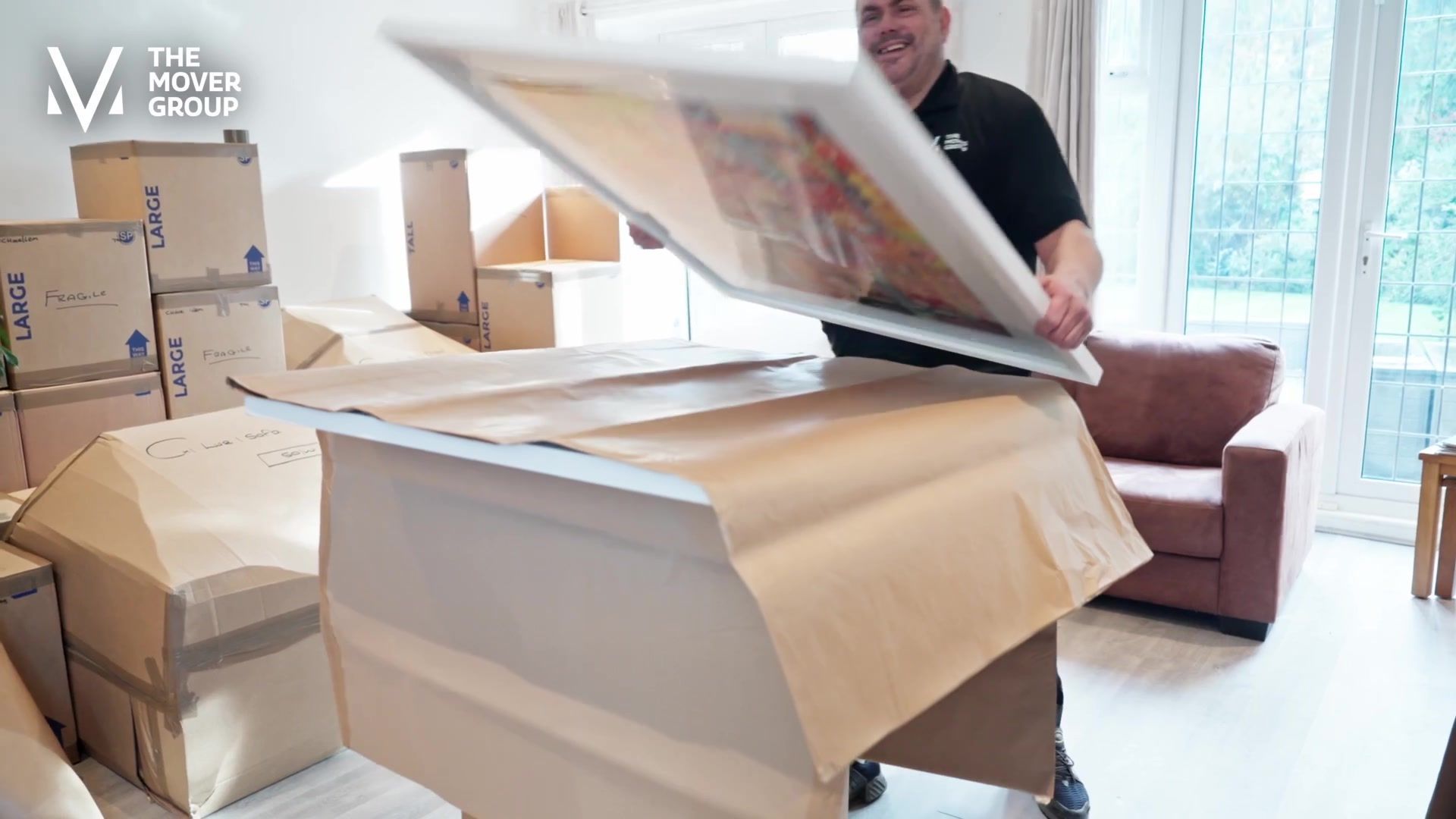
Solid timber expands and contracts with moisture content. Furniture that has spent thirty years in a centrally heated London house at 40 to 50 per cent relative humidity is going into a climate where outdoor humidity regularly exceeds 80 per cent and indoor air conditioning drops it sharply again. That cycling is what splits panels and opens joints. We pack timber with moisture barriers and desiccant inside the crate, avoid direct contact with container walls, and where a piece is genuinely valuable we recommend a purpose-built crate rather than blanket wrap.
Fine art and framed works
Canvas is hygroscopic — it takes up moisture and slackens, then tightens again, and paint layers crack. Frames with gesso and gilding are worse still. Our fine art handling uses acid-free interleaving, corner protection, a sealed moisture barrier and a rigid outer crate, and for high-value works we ship by air rather than sea specifically to shorten the exposure window. Where a collection is significant, the honest advice is often that part of it should not travel at all and should stay in climate-controlled UK storage for the duration of the posting.
Musical instruments
Pianos, stringed instruments and woodwind are the most climate-sensitive items in any household. Strings slacken, soundboards crack, glue joints fail. Instruments should be professionally prepared before packing, crated individually with humidity buffering, and where possible shipped by air. A grand piano crossing to Dubai by sea in July is a risk we will always discuss frankly with the family before accepting it.
Electronics and appliances
Condensation inside sealed units is the main threat, followed by voltage. The UAE runs 220–240V at 50Hz on Type G plugs, so British appliances work electrically — but warranties frequently do not travel, and service networks for UK-market models are patchy. Large white goods are rarely worth shipping when the destination property is already fitted out. Televisions above a certain size are cheaper to replace in Dubai than to ship and insure. We pack electronics double-boxed with desiccant and recommend a settling period before anything is powered up on arrival.
Textiles, rugs and books
Wool, silk and paper are all vulnerable to mould. Rugs are rolled, wrapped in breathable material rather than sealed plastic, and treated for insects where appropriate. Books travel in small, well-sealed cartons with desiccant — a library packed loosely into large boxes and left in a hot container for five weeks will arrive smelling of the container.
What are realistic timings for international removals to Dubai, and how do Ramadan and the summer peak affect scheduling?
A sea freight shipment from London to Jebel Ali typically takes 18 to 25 days port to port, with a realistic door-to-door window of five to seven weeks once packing, export formalities, sailing, clearance and delivery are included. Air freight runs three to seven working days transit, with a door-to-door window of ten to fourteen days. Groupage — shared container space — adds one to three weeks for consolidation.
Those are the mechanics. The calendar is what actually determines whether a posting lands smoothly.
Ramadan
During Ramadan, working hours across UAE government departments and ports are shortened, and customs clearance slows accordingly. Delivery crews work reduced days and it is inappropriate to expect long physical labour in the afternoon heat during fasting hours. Eid al-Fitr then closes offices entirely for several days. Ramadan moves in the calendar by roughly eleven days each year, so a posting date that worked comfortably one cycle may sit awkwardly the next. We plan mission shipments to clear either well before Ramadan begins or after Eid — not across it.
The summer peak
Two pressures collide between late June and early September. UK families move around the school year, so demand for packing crews and container space peaks in July and August. At the same time, Gulf summer temperatures make delivery days genuinely punishing and container interiors dangerous for sensitive goods. Missions that can shift a rotation to May or to late September get better crews, better rates and better outcomes. Where the posting date is fixed by the sending ministry, we build in earlier packing and use air freight for the climate-sensitive fraction.
Other calendar points to plan around
- UK school holidays and half-term — the busiest weeks for crew availability across London.
- UK bank holidays — port and haulage capacity tightens either side.
- UAE National Day (2–3 December) and other public holidays, which close clearance offices.
- Friday and Saturday — the UAE weekend is Saturday and Sunday, with Friday a short working day.
What does each stage of a Gulf posting move actually look like?
Below is the sequence we run for a mission relocation from London to Dubai or Abu Dhabi, with realistic timings and the specific things that delay each stage. Coordinators can use this as a planning skeleton and work backwards from the officer's reporting date.
| Stage | What happens | Typical timing | What delays it |
|---|---|---|---|
| Survey and scope | Home survey in London, volume assessed, ship/store/replace decisions taken, fixed price issued | 8–12 weeks before departure | Posting date unconfirmed; destination property not yet allocated; family unavailable for access |
| Documentation build | Privilege letter raised by mission, MOFA endorsement, passport and visa copies collated, valued inventory prepared | 4–8 weeks before departure | Visa not yet issued; exemption letter naming the wrong consignee; dependants added late |
| Packing and crating | Export-standard packing, climate protection, crating for art and instruments, numbered inventory signed | 1–3 days on site | Restricted parking or lift access in central London; more volume than surveyed; last-minute additions |
| UK export and loading | Container loaded or groupage consolidated, export declaration filed, bill of lading raised | 2–10 days after packing | Groupage consolidation waiting on volume; port congestion; bank holiday haulage gaps |
| Sea or air transit | Vessel sails to Jebel Ali, or air freight to Dubai or Abu Dhabi | Sea 18–25 days; air 3–7 working days | Transhipment delays; blank sailings; Red Sea routing changes |
| UAE customs clearance | Documents lodged, privilege exemption applied, inspection if selected, duty waived or assessed | 2–7 working days (mission); 3–10 (private) | Ramadan and Eid hours; vague inventories; restricted items declared late; consignee mismatch |
| Delivery and unpack | Delivery to villa or compound, placement, unpacking, debris removal, condition check against inventory | 1–2 days on site | Compound access permits; lift booking; keys not released; summer working-hour limits |
| UK storage account | Retained items inventoried and held in the UK for the duration of the posting | Duration of tour, typically 2–4 years | Inventory not itemised at intake, making retrieval and repatriation slow |
What should a family ship, what should stay in UK storage, and what should be replaced on arrival?
The short answer: ship what is irreplaceable, personal or genuinely expensive to buy again; store what is climate-vulnerable, seasonal or tied to a UK property; replace what is bulky, cheap in the UAE or already provided in the destination property. Getting this split right is the single largest cost lever in any Gulf posting, and it is where a good survey earns its fee.
Ship
- Personal effects, clothing and children's belongings — familiarity matters enormously in the first fortnight.
- Heirloom and antique furniture, provided it is properly crated and climate-protected.
- Curated art, books and instruments where the collection is part of the family's life rather than an investment being stored.
- Kitchenware, tableware, linen and the small items that make a villa feel like a home.
- Bicycles, sports equipment and hobby kit that would be costly or awkward to rebuy.
Store in the UK
- Winter coats, boots and heavy woollens — a Gulf posting needs a fraction of a British wardrobe.
- Garden furniture, lawnmowers, sheds and anything tied to a UK garden.
- High-value art and instruments where the risk of climate exposure outweighs the pleasure of having them out.
- Documents, archives and sentimental items that do not need to be in transit twice.
- Anything the family will want immediately on repatriation — kept itemised, so retrieval is not an excavation.
Replace on arrival
- Large white goods, where the villa is already fitted.
- Oversized televisions and bulky low-value furniture — shipping cost frequently exceeds replacement cost.
- Mattresses and bed frames, where UAE sizing differs from UK sizing.
- Consumables, cleaning products and anything liquid or perishable.

Why do embassy HR coordinators use The International Mover for Gulf postings?
Because a mission move is an administrative process as much as a physical one, and the coordinator needs one named person to call. Every relocation we handle is assigned a personal move manager who holds the documentation timeline, the packing standard and the destination access arrangements in one place. We quote transparent fixed pricing, so a mission budget holder is not managing surprises mid-posting.
The Mover Group is an IAM Premier Member — the highest tier of membership of the International Association of Movers. That matters practically as well as reputationally: it governs the standard of the destination agents we appoint in Dubai and Abu Dhabi, and it means the firm handling delivery at a villa in Al Bateen is held to the same standards as the crew who packed the house in Kensington.
Onkar Sharma, who founded the company, brings 30+ years of personal experience in international relocations, much of it moving diplomatic and executive families. That experience predates The Mover Group — we are a young, specialist family business, deliberately smaller, taking a limited number of relocations each month so that every client receives concierge-level attention rather than being processed. Across our diplomatic work we have handled close to 1,000 families in diplomatic relocations to the Middle East.
Customs clearance is not an optional extra bolted on at the end. We manage export formalities in the UK and coordinate clearance and duty exemption at destination through our appointed agents as part of the relocation, with the documentation set built alongside the mission rather than chased after the container has sailed.
We also handle the things that sit outside a normal household shipment. Vehicles, including collector and high-performance cars, move under our supercar logistics arm using enclosed transport and full documentation support — a service London clients use regularly for UK-to-Dubai vehicle movements. Fine art, wine collections and instruments are handled by crews who crate them properly rather than blanket-wrapping them and hoping.
Frequently asked questions
How long do international removals to Dubai take from London?
Allow five to seven weeks door to door by sea freight, comprising 18 to 25 days port to port plus packing, export formalities, clearance and delivery. Air freight reduces this to ten to fourteen days door to door. Groupage adds one to three weeks for consolidation. Mission shipments with correct privilege documentation usually clear UAE customs in two to seven working days.
What paperwork does a diplomatic household goods shipment to the UAE require?
Passport and diplomatic ID or visa copies for the officer and all dependants, a duty-exemption or privilege letter raised by the receiving mission and endorsed by the UAE Ministry of Foreign Affairs, a detailed valued inventory in English, the original bill of lading or air waybill consigned correctly, and provenance paperwork for high-value items. Vehicles require additional registration and specification documents.
Should we avoid moving to Dubai during Ramadan or the summer?
Where the posting date allows, yes. Ramadan brings shortened government and port hours, slower clearance and reduced crew working days, followed by Eid closures. July and August combine peak UK demand with extreme Gulf heat that is punishing for delivery crews and harmful to sensitive goods. May and late September are consistently the best windows for a Gulf rotation.
Will our British furniture and electronics survive the Dubai climate?
Most will, if packed correctly. The UAE runs 220–240V at 50Hz on Type G plugs, so British appliances work electrically, though warranties and service cover often do not transfer. Timber, canvas, instruments and books need moisture barriers, desiccant and rigid crating. Genuinely climate-sensitive items are often better held in UK storage for the duration of the posting.
Do you handle UK storage for items we are not shipping?
Yes, and for a posting this is usually part of the same project. Retained items are itemised at intake rather than logged as unmarked boxes, so that three or four years later the family can retrieve specific things without unpacking the whole account. Storage runs for the duration of the tour and feeds straight into the repatriation shipment.
Is The Mover Group an IAM member?
Yes. The Mover Group holds IAM Premier Membership — the highest tier of the International Association of Movers. This governs both our own standards and those of the destination agents we appoint in Dubai, Abu Dhabi and across the Gulf.
How do we start planning your Gulf posting?
Begin with a survey, ideally eight to twelve weeks before the officer's reporting date, and bring us the posting calendar even if the destination property is not yet allocated. From there we build the documentation timeline backwards from the reporting date, agree the ship/store/replace split with the family, and issue transparent fixed pricing that the mission budget holder can rely on.
To discuss international removals to Dubai, Abu Dhabi or any Gulf mission — for a single officer or a full rotation cycle — call us on 0203 318 2216, email sales@themovergroup.com, or use our contact page. For missions arranging multiple postings a year, we are glad to hold a standing briefing with your HR team so that each rotation starts from a plan rather than a scramble.
Every move is personal.